


Unlike today, the early Universe was filled mostly with neutral hydrogen, formed from protons and electrons that combined shortly after the Big Bang. Observations of distant quasars reveal that most of this hydrogen was reionized within the first billion years—a period known as the Epoch of Reionization. Yet, the sources and evolution of reionization remain uncertain.
Recent observations from the James Webb Space Telescope (JWST) suggest that the massive stars in early, compact galaxies produced enough ionizing photons to complete reionization. However, it remains unclear how many of these photons actually escaped their host galaxies to ionize the intergalactic medium. Evidence indicates that stellar feedback—from both radiation and supernovae—is critical for clearing pathways that allow ionizing (LyC) photons to escape. For example, in cosmological simulations of galaxy formation, LyC escape peaks after supernova-driven winds clear galaxies of neutral gas and dust.
Because direct observations of LyC escape in the early Universe are impossible, astronomers turn to local analogs of the first galaxies to study these processes. Professor Renyue Cen and postdoctoral researcher Cody Carr have investigated the properties of galactic winds in nearby galaxies that emit ionizing radiation. In their paper “The Effect of Radiation and Supernova Feedback on LyC Escape in Local Star-forming Galaxies,” they proposed a new LyC escape sequence in which ionizing photons escape before the onset of supernovae—based on circumstantial evidence and radiation transfer modeling of spectral lines. Their predictions contrast with those of modern cosmological simulations.
In a follow-up paper submitted to Science, “Supernova-driven Winds Impede Lyman Continuum Escape from Dwarf Galaxies in the First 10 Myr,” Carr, Cen, and collaborators sought to isolate the time evolution of galactic winds and directly observe the LyC escape sequence. Using spectra from six local galaxies observed with the Hubble Space Telescope (HST), they traced the evolution of galactic winds alongside the LyC escape
fraction (fesc), confirming their earlier predictions. Figure 1 shows these spectra: as fesc decreases with time, the absorption lines broaden (indicating higher velocities) and deepen (indicating higher densities), revealing an accelerating and increasingly massive wind.
An artist’s rendering of the inferred LyC escape sequence is shown in Figure 2. LyC escape peaks early—before the onset of supernovae—when the starburst is younger than about 3 Myr. During this phase, radiation and stellar winds drive a relatively slow outflow. Between 3 and 5 Myr, the first supernovae explode, accelerating the wind and entraining more gas and dust. Although low-density may appear, fesc continues to decline on average. After roughly 5 Myr, the wind’s column density becomes sufficiently high to completely block LyC escape.
These results suggest that cosmological simulations must incorporate more accurate treatments of radiation feedback to correctly capture how star-forming galaxies contribute to reionization.
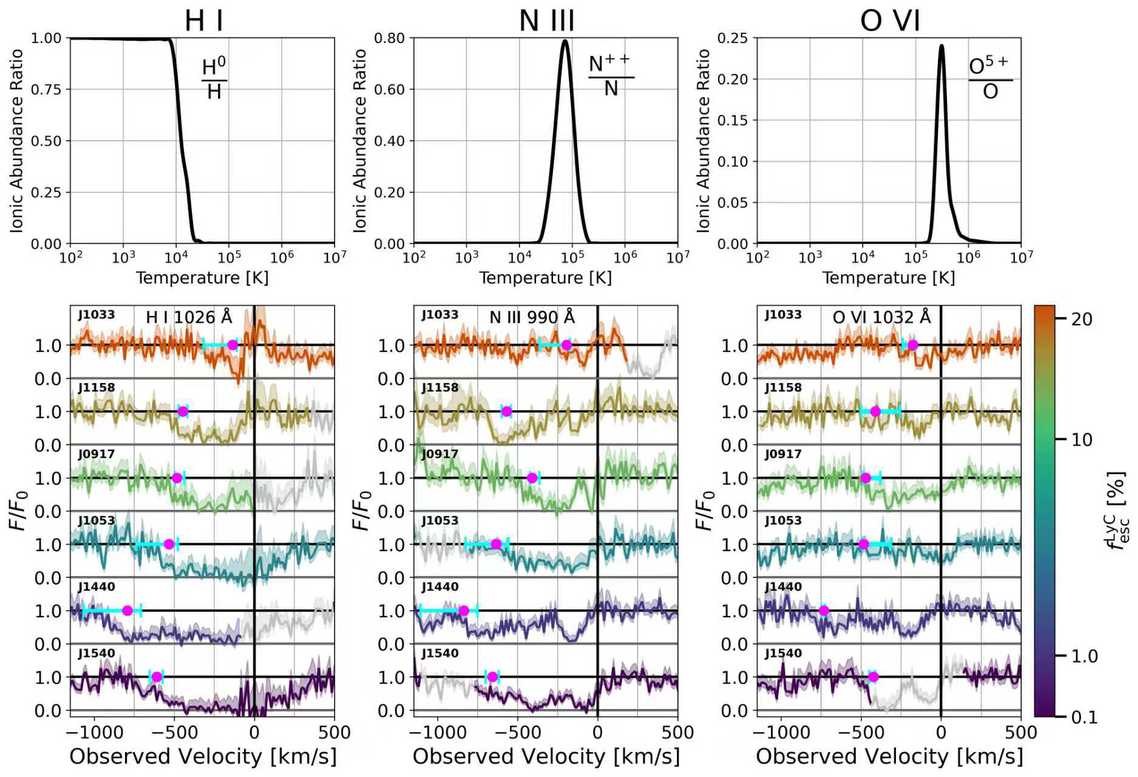
Figure 1: Spectra of six galaxies observed with the Hubble Space Telescope (HST). Each color represents a new galaxy and time anti correlates with fesc. Each column represents a different ion, probing the temperature range shown. Magenta points represent the observed velocity of the wind measured at 90% the equivalent width, a measure of terminal wind speed.

Figure 2: A new sequence for LyC escape proposed for compact, star forming galaxies.
