


Title: Current Status and Prospects of Astronomical Optical Telescopes
Speaker: Xiangqun Cui
Inviter: Xi Kang
Time: 15:30pm, December 18(Thursday)
Location: Room 215, No. 8 Hainayuan Building, Zijingang
Abstract:
The scientific frontier of astrophysics has always driven the continuous development of observational technologies and equipment, while new achievements in observational techniques have also provided astronomy with new horizons and discoveries. Over the past few decades, from the late 20th century to the present, advancements in fields such as optics, computing, automation, and precision machinery have greatly enhanced the capability to develop astronomical telescopes, leading to the construction of a large number of telescopes incorporating new technologies. The emergence of these telescopes has led to significant progress in measuring the fundamental parameters of the universe, understanding the formation and evolution of galaxies and stars, discovering and studying exoplanets, and uncovering the nature of dark matter, dark energy, and black holes. The frontier research in astrophysics in the new century also places new demands on astronomical observation equipment. This report will introduce the current development status and prospects of international and domestic astronomical optical telescopes.
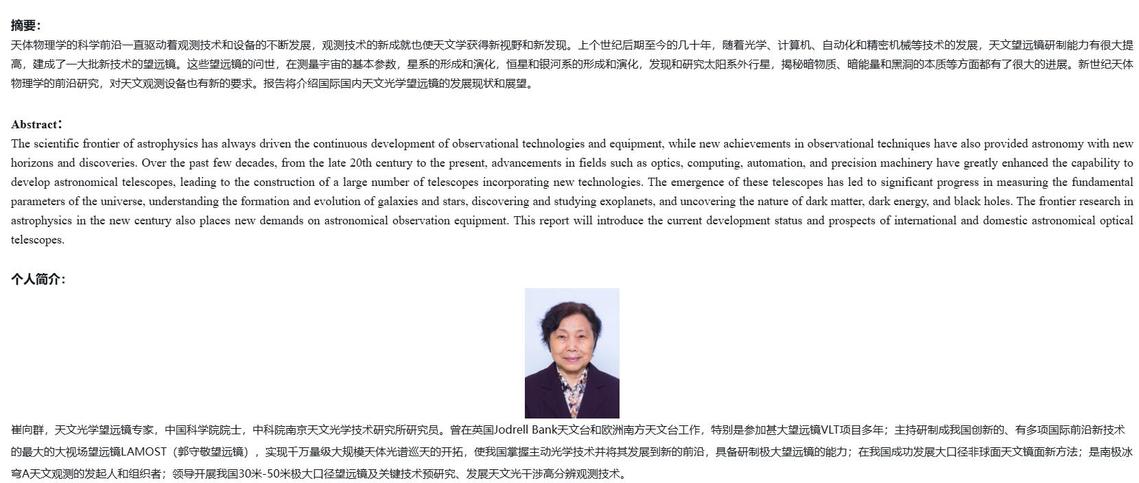
Bio:
Xiangqun Cui, an expert in astronomical optical telescopes, is an academician of the Chinese Academy of Sciences and a researcher at the Nanjing Institute of Astronomical Optics & Technology. She has worked at the Jodrell Bank Observatory in the UK and the European Southern Observatory, with extensive involvement in the Very Large Telescope (VLT) project. She led the development of China’s innovative Large Sky Area Multi-Object Fiber Spectroscopic Telescope (LAMOST, also known as the Guo Shoujing Telescope), which incorporates multiple cutting-edge international technologies as the country’s largest wide-field telescope. This achievement enabled pioneering large-scale spectroscopic surveys of tens of millions of celestial objects, mastering active optics technology and advancing it to new frontiers—thus equipping China with the capability to construct extremely large telescopes. She also developed new methods for manufacturing large-diameter aspheric astronomical mirrors in China. As an initiator and organizer of astronomical observations at Dome A in Antarctica, she has led preliminary research on key technologies for China’s 30–50 meter extremely large telescopes and pioneered high-resolution astronomical optical interferometry techniques.
